
Therapists Are Not Parents
Are we simulating family?

I’m always being told not to turn the people I love into my therapists. There’s a lot of worry about emotional labour these days, about overburdening people. Our loved ones should not be expected to provide excessive emotional support. Your friend is not your therapist, we are warned. Your partner is not your therapist. Your parent is not your therapist.
But something we forget, I think, is the inverse. Your therapist is not your friend. Your therapist is not your partner. Your therapist is not your parent.
One in four Gen Z adults went to therapy as teens, including 31% of young women. This compares to only 10% of Gen X and 4% of Boomers at the same age. I’ve spent a long time wondering what changed. Of course some of us are suffering and need professional help—but others talk to their therapists like friends, texting them obsessively. And lately I see something deeper happening too, something parental. I notice young people treating their therapists like family, going to them for praise, approval, affection, the things children need from parents.
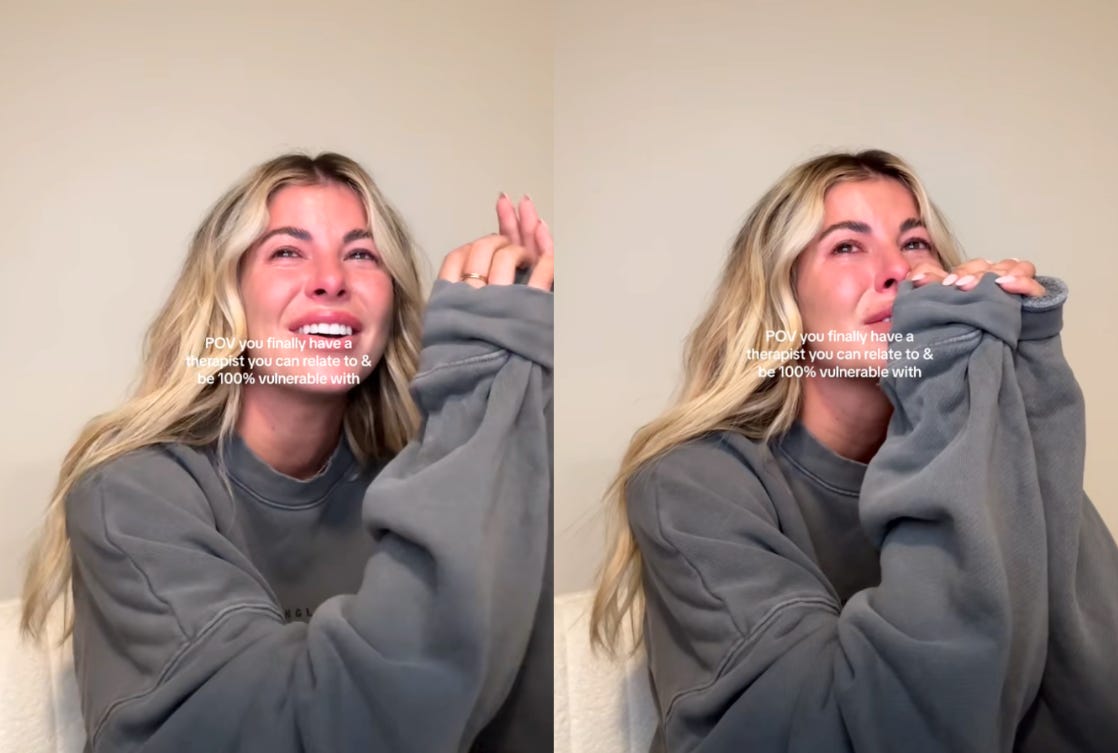
Today we can text our therapists anytime. We can message them about our day, tell them anything on our mind. They are available 24/7. They are here to take care of us, finally someone who wants the best for us. We love when they praise us, like us, tell us we are beautiful. Some wish their therapist would adopt them; many want to be their favourite. That’s what therapy is, to more and more young people, a place to hear that someone is proud of them, to be checked in on, to be told they are doing great.
Therapists online indulge this, too. They speak like parents. “Yes, therapists actually love you” and are “protective af over you”, we’re told. “Yes, your therapist misses you too,” they insist, #yourtherapistcares. Here are “signs your therapist likes you”, that “you’re probably their favourite”! Your family may have failed you, but don’t worry, “This is your reminder that your therapist gets excited to see you, too. The attachment goes two ways. That’s what makes this work so profound & so beautiful.” Then there’s the ads, the companies. “We’re proud of you,” Talkspace tells us, “You are loved.” BetterHelp sees you and hears you because “You deserve all the love and care in the world”. Funny how we worry so much about the rise of therapy-speak in our relationships, but never worry about this weird family-speak with our therapists.
There’s all this infantilisation too, this obsession with our inner child. Of course talking about childhood is part of some therapy but I don’t mean psychoanalysis, I mean therapists treating patients as if they are their children. Healing your inner child seems to mean regressing to being a child—being spoken to like a baby, treated like a toddler, paying for attention and affirmation. Therapists are getting attached too, acting like proud parents, posting about missing their clients and how much they love them, crying when they leave, verging on surrogate figures. BetterHelp even offers “reparenting therapy” that literally provides “the type of parenting your own parents were unable to give you in childhood.” And it’s strange because we seem to accept that so many of us feel hurt and abandoned but never go near why, never name the problem. I find this weird, this insistence that we are all wounded children but incuriosity as to what happened, what might have caused it.
This is happening, I suspect, because of family breakdown. For all the discussion about Gen Z’s demand for therapy, something barely mentioned is the decades-long collapse of the family. Divorced parents, single parents, overworked parents. Shrinking and strained and scattered families. My argument here is not only that traumatised children are in therapy to understand problems with their family, but that they are simulating family, with therapists. I’m not sure it’s the therapy part people want. I’m beginning to think it’s re-enacting what we needed in childhood: someone to talk to, to rely on. Of course some young people need serious therapy. But I think many more need parents.
And yes, previous generations had their families fall apart too, but we are the first to have so many simulations, all these replacements. After the weakening of the family came the rise of state and professional substitutes, and with them, the assumption that only the advice of educated experts can be trusted. And so therapists today help with everything. They guide children through coming-of-age, get them through girlhood. They are here to teach them how to date, how to cope with new schools, how to accept their changing bodies, how to handle rejection from a crush. Young adults go to therapy for career advice, for dating advice, for “big life changes” like “adulting” and “heartbreak”. Our parents can’t possibly help with these things anymore; they aren’t professionals. Your dad is just unhelpful, says BetterHelp, and so are your friends. And so that’s what we want, more than anything, not only a psychological understanding of ourselves but advice, authority, direction.
We lowered expectations for parents and raised expectations for professionals. The assumption today is that it’s healthy to rely on experts, unfair to rely on family. Which is why we have a constant cry for more mental health funding and better access to resources, but barely anything for defending families, for expecting parents to stay together or spend more time with their children; that would be backward. Children deserve dependable therapists, apparently, but not dependable families. Children have a natural need for mental health resources, but not for the most natural thing in the world, two attentive parents. And how ironic, painfully ironic, that we have all these therapists telling young people not to be too close to friends and family, never to be codependent, to put up boundaries, to keep a healthy distance from those who love them, to distrust people who are human and disappointing and sometimes hard to understand, but rely completely on someone who needs their card details, who is emailing over invoices, who has to sign out after fifty minutes. We are warned against codependent families while we are encouraged to call and text therapists and trust everything they say.
That’s what bothers me, this emphasis on estranging ourselves. It’s the combination of online therapists telling us to trust them more and more while giving us 6 SIGNS OF TOXIC PARENTS and warning us our families are actually abusive and helping us cut them off. Maybe I wouldn’t mind all this talk about attachment styles if we weren’t essentially encouraging people to be anxiously attached to experts instead. Don’t be dependent on your family, we’re told, but do text a therapist every day. Sorry you have to deal with “certain family members”, why not try Talkspace? Don’t want to talk about your crush or maths test with those who love you? Download our app! To me this feels dangerous, telling a generation to be so merciless with friends and family while insisting that therapists really care.
But now some are realising this is not enough, this is not real, this is like everything else in our world, a simulation. Therapists do not care the way family does; therapists are paid to listen. The whole thing is transactional, transient, time restricted. People worry about attachments to AI therapy bots and what that will do to a generation but I honestly think human therapists are already a concern. Because we have spent so long ignoring the real problem, being sold substitutes for what we lost; in the same way Gen Z got influencers instead of friends and YouTube instead of experiences, we were told to fix the pain with psychologists and #TherapyTok and BetterHelp discount codes, and forgot what we were simulating in the first place.
So no, I don’t believe the answer is as simple as more mental health awareness, more resources, more funding. I don’t think it’s more experts who are more and more available. I think it’s parents trying harder to stay together and to stick around. I am convinced that what so many young people are desperate for here is an adult, just one adult, guaranteed to show up every week, to listen, to care, to tell them right from wrong, to correct and guide them. They are craving the time and sustained attention all humans need, especially when they are young, someone who will not give up and will not go anywhere. And how unbearable that they think the only way to get that, the only way to cope with the uncertainty and anxiety, the only way to say please don’t go and actually be heard, is to pay someone.
I’m sure therapy helps many young people. But when we find ourselves paying a stranger to tell us they are proud, logging into Zoom to be listened to, needing experts to assure us we are enough, we should wonder what we are really looking for, who we really needed to hear this from. We might not be paying for therapists. We might be paying for parents.
If you appreciated this essay, I expand on my thoughts on the mental health industry in my debut book, GIRLS®, out soon and available now for pre-order!
UK:
Amazon / Waterstones / All retailers
US:


Brilliant as always ...
I hope you'll write about the reverse as well — being from Southern Europe, whenever a friend says "sorry to dump on you," I go, that's what friends are for! You should be able to share your grief & sadness with friends. When did it become a norm to have to pay someone exorbitant fees only to be able to open up about our normal, common human problems?
Yes—well said. And as a psychologist specializing in parental estrangement, I would add that therapists can also contribute to a false model of what one can—or reasonably should—expect from parents: namely, that parents, like therapists, should be endlessly empathetic, exquisitely attuned, and unconditional in their love, regardless of constraints such as limited financial resources, troubled marriages, or their own histories of childhood adversity. Within this framework, the failure or inability to provide that *therapeutic* level of care (barring genuine abuse) is treated as a reasonable justification for estrangement.
The broader culture reinforces this myth by implying that if the now-adult child had received that level of attunement, they would be a fully realized and empowered person—rather than the anxious, struggling, or insecure individual they have become.
As sociologist Eva Illouz writes: “Far from being unable to bestow coherence on a given life, therapeutic narratives can be faulted for making too much sense of one’s life of binding too tightly the present the past and the future in a seamless narrative of psychic wounding and self-change.”