


Much has been said about a Christian revival among Gen Z. Some statistics are disputed, but there does seem to be something happening.
I’m curious about Christianity myself, and have noticed changes lately, conversations with young people who were raised as atheists and almost wish they hadn’t been, who wonder what it would have been like to grow up with more guidance and guardrails. That does seem new, different from even when I was a teenager. But part of me is still sceptical. For a while I thought my generation might be finding God. Now I worry we are just finding content about God.
There is a lot of Christian content online. Learning about the faith feels easier than ever: follow Christian influencers, listen to Christian podcasts, scroll through Christian hashtags; the Bible is bite-size now! Of course this has been happening for a long time, Christianity being made easier and more convenient; Neil Postman warned in the 1980s that TV was turning faith into a form of entertainment. But now it feels as if all of Christianity can be done on a screen. To stay connected with God, all we need to do is subscribe, download, press play.
Then there’s the commodification of Christianity. This is nothing new either, the merchandise and celebrity pastors and nightclub churches. But now, with smartphones and social media, the market intrudes on almost every religious ritual and tradition. Pay $6 per month to pray, $399.99 to listen to the Bible for a lifetime. To become a Christian, begin your 7-day free trial now.
Some of this seems helpful. Being new to Christianity, I can’t pretend it’s not convenient. I’ve never read the Bible all the way through but I have an app that summarises it for me, that texts me a passage every day. I use #Bible and Hallow and Glorify. And I’m sure this kind of thing has attracted more young people, that it helps to meet a generation where they are. But I don’t know, lately I’m beginning to feel as if Christianity has become another thing to do on my phone. Now I need my faith fast and convenient. I can pray as I go. I can stay prayed up. I’ve got a Streak going.
Don’t get me wrong, I’m not saying that using a prayer app is as bad as scrolling through TikTok. I just think this is only useful if you have been Christian for a while. If you were raised religious, if you already have a prayer routine and a habit of going to church, then the Hallow app is probably great! It’s an extra reminder to pray, an accessory to your spiritual life. But I don’t think this helps new Christians, especially not Gen Z Christians. The problem with religious apps is the same problem we have with Instagram communities or with online porn, we encounter the virtual version of everything first, before the real thing. And so that becomes our standard. Supplements become substitutes. For us, faith is the live-streams and prayer apps and podcasts. “Connect with God in a New Way,” we’re told. But what if this is our first way, the only way we have ever known, through apps and algorithms?
This is why I worry about the gamification of Christianity too. On Hallow you can track your Prayer Streak and Game Streak, see where you rank in the Trivia Leaderboard, compare how many minutes prayed with friends and family. There are all these other apps too: Ascend, learn the Bible like a game; Glorify, climb the monthly leaderboard; FaithTime, play “short interactive mini-games that make faith feel doable”, even a Duolingo for Catholics, find out about faith from Streaks and XP scores and 5-min lessons! “What if the catechism was a game?”
Get used to playing a game and reality becomes boring. How on earth am I going to get through the Book of Psalms when I’m used to iBible? Now I need the New Testament to be YouTube Shorts. Sure I can Take a minute to connect with God, but then it better be just a minute, anything more is agonising. Don’t worry, my apps reassure me, it’s just a few minutes a day, alright just one minute, actually “just give Jesus like 30 seconds.” I don’t know about this, the gamification of connecting with God. These companies need users to keep coming back, so more than anything their apps have to be entertaining, so engaging we “can’t stay away” from them. “What if learning the Catholic faith felt addictive?” The best thing about Hallow, according to one review on their website, is that it “facilitates prayer in a way that works within my 2020 brain.”
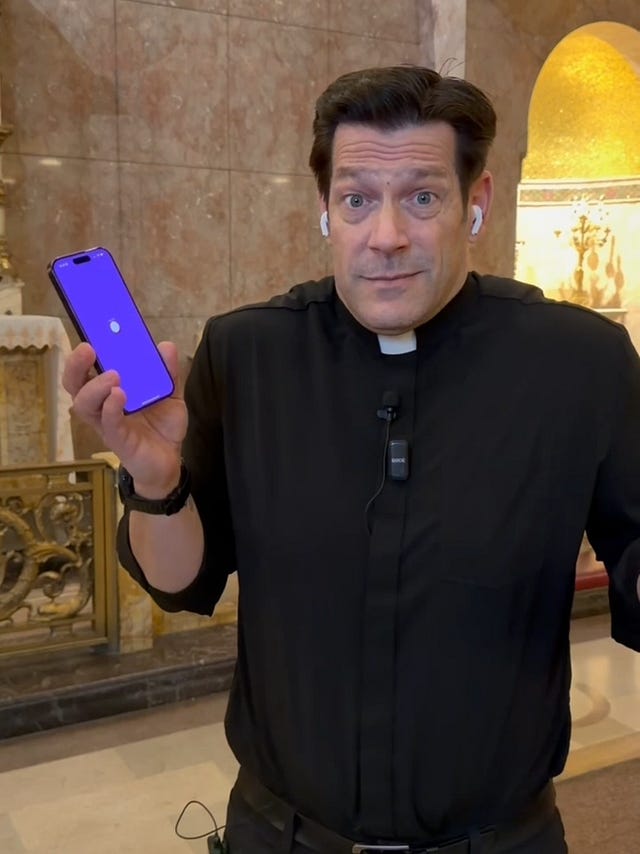
 Tiktok failed to load.
Enable 3rd party cookies or use another browser
But if you are new to faith, you haven’t developed real habits. This is a huge hurdle, trying to stick to a routine, show up every Sunday, even remember that it’s Sunday and that this is something you do now. Embarrassing to admit but I’m always thinking of ways to duck out of church early, to ditch a weekend here and there. Sometimes I think I’ll just watch the Sunday live-stream in bed, maybe skip through it a bit, or actually you know what I’ll just listen to a Christian podcast instead while I get on with other things. All the Sermons are on Spotify anyway! The awful truth of it, I have to be honest, is that I put off going to church because I know that I can. I’ve got my phone.
This is also a problem with the promise of online communities. If you don’t have a parish or a prayer group, no need to worry, now you can download one on the App Store! If you have questions about faith, try talking to Hallow AI. Ask the Bible Chat “anything, anytime.” Watch live-streams to “Find the Pastor Who Truly Gets You”. Download FaithTime to “Scroll, play…and keep growing with a community that actually feels alive.” The Blessed App is “the only online community you’ll ever need”, “the community you have been looking for.”
Of course I understand the intent. By far the most intimidating part of approaching faith, at least for me, is stepping into church as a complete outsider. So I get trying to make that easier, trying to encourage young people to dip their toes in first and start online. But after a while the real thing becomes even more daunting. There seems to be this paradox in modern life, we make things so convenient we assume they will happen more and more, but it’s almost as if they become too available, we start wondering what’s the point, we can’t be bothered. There’s always an easier way. There’s an Alpha course near my house but there’s also one on the App Store. I tell myself I’m watching the Sunday live-stream to get used to the idea of going to church, then I’ll actually go. But this is the trap, and trust me on this, if you are trying to reach a generation that has spent more time on screens than face-to-face with other human beings, do not make it any easier to do things inside.
All of this, the commodification and the gamification and the online communities, ultimately leaves us with a shallow faith. If you teach a generation Christianity through TikToks and Instagram Reels, don’t be surprised if their version of belief has nothing to do with virtue, with how they actually live their lives, and everything to do with what they post, how they label themselves online, what’s on their Story. Don’t be surprised if Christianity becomes nothing but a weapon in the culture war, a cross emoji in a bio. If companies focus on expanding their customer base, instead of changing hearts and souls, that’s what we’ll get, customers. Consumers who want to pick and choose, browse and shop, personalise and pray their own way. Deep down I’m not convinced that’s what my generation even wants, not really. If you’re young and you weren’t raised religious and you find yourself drawn to faith surely it has to be because it’s different, because it’s a break from ads and notifications and discount codes. For the first time in our lives let us relate to something not as a consumer, please, I connect with everything this way, not God too.
Who knows, maybe in the future many of us will say we found Jesus through a YouTube Short, that God got recommended by our algorithm. But I doubt it. I think if Christians want to reach my generation, really reach us, they have to promise something totally separate from that, something otherworldly, something that doesn’t abide by market logic, something different, divine. Something, for once, that isn’t cheapened or commodified. And I hope some find the conviction to say that their faith is too complicated, too sacred, to turn into TikToks. If you want to know more about it, the subscribe button won’t help. You’ll have to step into church.
Interesting.
My take has been the abundance of convenience has created a scarcity of meaning.
And even in its shortest forms, faith is an enduring vessel for just that.
I’ve personally found the Catholicism I grew up with far more resonate in recent years.
Hello dear Freya,
This must be very difficult! I was born a Catholic, then fell away from the faith, and have now returned. What has been very helpful for me recently is speaking openly to my priest and several nuns *in person*, and following their guidance. You’ll be made welcome, I’m sure.
Perhaps a delightful thing about Catholicism in the modern age (among multitudes) is that none of the sacraments can be administered through a phone…apps have zero authority here. Grace is mediated through embodied reality - one cannot be baptised, absolved, confirmed or share in the Eucharist through a screen. The Church has things that require a physical and spiritual presence that internet absolutely cannot give you.
Many blessings, and you’re in my prayers 🙏🏼