


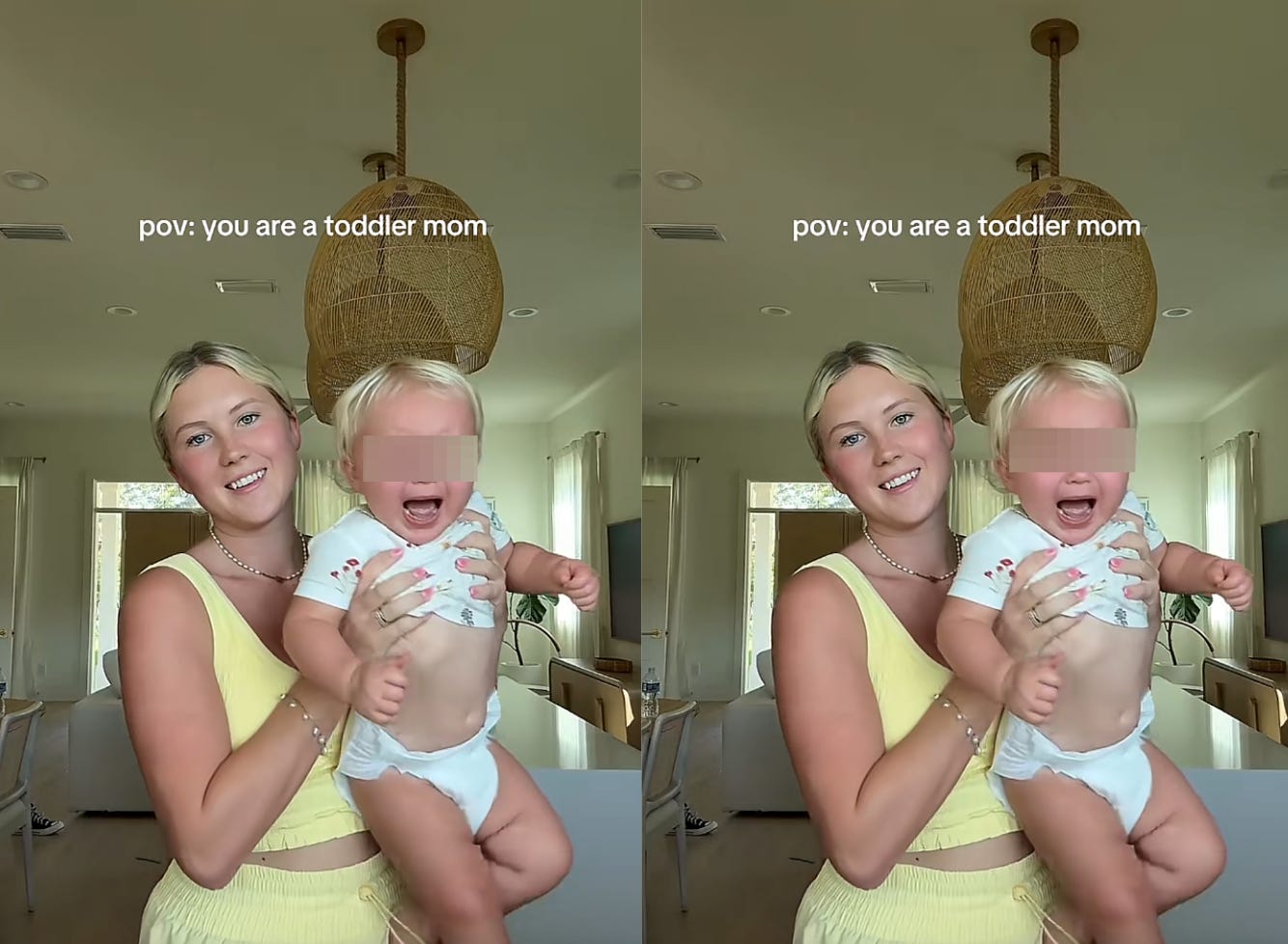
We often hear about women being objectified online: scrutinised by strangers in comment sections, rated out of ten by grown men, generated into sexual images. I have argued for some time that on social media, women become objects.
But the truth is that’s only half of it. Women also objectify. We rate and review each other. We objectify boyfriends, who become accessories for Instagram, or tripods to take pictures of us. We objectify friends, who become things to pose with. And worst of all, we objectify our children.
Online, children are treated like products, held up in front of ring lights, hanging off arms like handbags. They are props, part of the stage, arranged in the background while mothers pose, carefully positioned in frame for more views. Every TikTok trend women do, children are dragged into: Get ready with us, toddler tantrum edition. Outfit of the day, but on babies, dressed and dangled in front of the camera. Skincare routines, but on three-year-olds. Children have dance routines to practise, costumes to wear, skits to rehearse. Even the sweet moments—the first steps and birthdays and Christmas mornings—involve multiple takes, lines to be learnt, poses to be wrestled into.
Some influencers, of course, market the worst moments too: children are recorded at the dentist, at the hospital, getting sick and wetting the bed and annoying their parents. Toddlers are pranked for clicks: splashed in the face, smacked on the head, terrified with filters and filmed while they cry. We can follow their potty-training journeys on TikTok, or watch them being sent to the naughty step. These mothers often justify the public humiliation of their children as being transparent, just being realistic and relatable, as if this is some form of activism, something owed to their audience, forgetting that the life they are offering up is not their own. Spend the day with us, they smile to strangers, holding up their children to invite them in.
I’m not sure what to call this other than objectification, using other human beings as things, as instruments for our own purposes. Objectifying women means seeing them mostly as a tool for sex; this is seeing children mostly as a tool for views. Everything wrong with the objectification of women—exposing them without their consent, offering them up to the judgement of strangers, measuring their worth by online metrics—is how more and more women treat their children online.
Even if most mothers don’t do this, this is what millions of women are scrolling through every day. We talk all the time about how dating apps dehumanise people, about how swiping through so many profiles makes us forget there are human beings behind them, with their own thoughts and feelings. But there is something dehumanising about mindlessly scrolling through anything online. This changes how we see children too. It has to—seeing newborns held up to the camera the same way skincare products are, seeing babies born into sponsored ads. I have never held a baby in my life but I’ve scrolled through thousands and thousands of them, as content, as accessories, as thumbnails, doesn’t that do something?
I think it becomes harder to see children as fully human. We only have to listen to the language some commenters use, how children are described. On one screaming toddler TikTok, viewed over 7 million times, the top comments are What does it want!? (30,000 likes) and why is it hitting itself. On another of a child having a #tantrum: What’s wrong with it. Mothers, too, have begun describing their children like TV characters, their lives nothing but shows to tune into. Don’t tell me that isn’t deranging, worrying about how an audience will receive your child, rate your child. And new; this has never happened to parents before. Never has there been such temptation to turn children’s lives into storylines, to orchestrate and script and manage their memories. Mothers are meant to protect their children from strangers; now they use their children to entertain them.
And this attitude doesn’t stay online. Social media is not the only place where children are treated as objects; I notice it all the time. Divorce is one example, where children have become possessions. Rather than encouraging families to stay together, apps and therapists and divorce coaches are here to help parents divide children up fairly between households, like furniture. In ads for the co-parenting app amicable, the option “stay together for the kids” is crossed out; just download their app instead. In confessional essays about divorce, mothers mention children sparingly, logistically, like remembering to mention what happened to the sofa. In celebrity announcements, the celebration comes first; children are an afterthought. They have become background scenery in their parents’ stories of love and liberation. So we reassure ourselves that they are resilient, durable, things that can be moved around and divided up without breaking.
This is not to say that all mothers think this way, that women aren’t bonding with their babies anymore. I don’t believe that. But I do believe that women today are up against it, that they have to actively avoid apps and TikTok trends and a culture insisting that children are inanimate. And actually this is true for all of our relationships now. If we want to experience real romantic love, we have to resist seeing men as objects, as products to search through, as disposable and easily exchanged. If we want to see our own worth, we have to remember that we are not things either, not meant to be rated and reviewed, not destined to be traded in once we lose value. And to see the humanity of children, their pain, their rights, their dignity, we have to stop treating them as props and possessions.
Hard to change all that, I know. I understand how we got here. Obviously we objectify people because that’s how many of us were taught to relate to everything, as consumers. Girls grow up advertising themselves on Instagram, learning that this is the only way to be loved, to be visible, go on to shop for partners on dating apps—and then they have children. How else to make sense of that change other than how they always have, through an audience, through their approval? And in a world where motherhood feels low status, irrational almost, this is a way to win back status, the sort of status that other women recognise and value—by making children into accessories, by marketing motherhood. And a way to find community, too, some company in hard moments. Tragic, really, that the only way some mothers feel they can let others into their lives, to feel recognised and understood, is to start recording.
My point is this: young women are so often warned about being objectified. But nobody warns us about anything bigger, that we too have to resist the objectification, the debasement, the dehumanisation of everyone we are attempting to love. We have to humanise other people. Ask ourselves why we want, need, an audience for everything. See the vanity of this, the misery of using children for views and validation. They will call it liberating and freeing and harmless, a life that casts us as the main character and everyone else as background scenery. But no, it’s a nightmare, not a life at all.
I do think it’s hard for women to feel fully human now. But some of that is because of how we treat other people. If you want to understand the pain and insecurity of young women today, look at how we are objectified online. But if you want to understand the vanity, the narcissism, the loneliness, look at how we objectify everybody else.
Thank you for broaching this subject. The Lindsay Clancy trial really brought a lot of this to light, I think — at least how pervasive this type of behavior is. I worry about the long-term harm these mothers are inflicting on their children. I could never dream of treating my children in this way. It is incredibly sad.
Oh my gosh, I forgot about that egg smash on the head trend 😭 So sad the look on the children’s faces. Lord have mercy. Some days I hope the apocalypse will take the internet.